
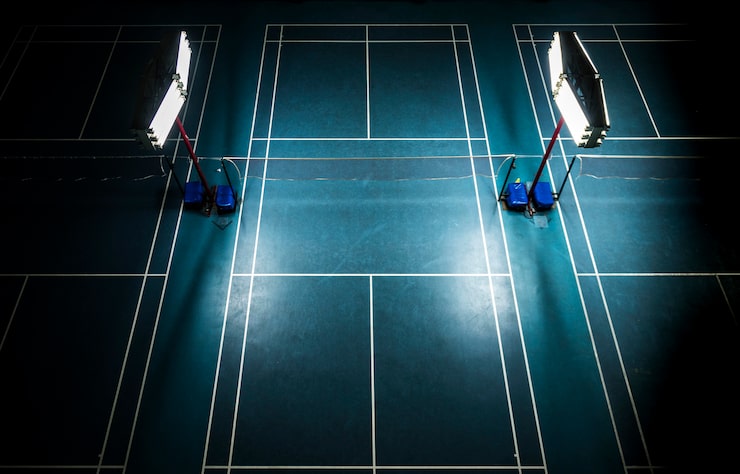
Anyone who has played a night match under poor lighting knows the frustration instantly. The ball disappears for a split second against a dark sky and suddenly a routine shot becomes a guessing game. That split second confusion isn't just annoying. It genuinely affects performance and safety on court. A properly installed tennis court light changes that entire experience completely.
Tennis is a sport of speed spin and split second reactions. Players tracking a ball traveling well over 100 kilometers per hour need consistent clear visibility throughout the entire court, not just in patches near the net. So what actually separates decent court lighting from genuinely excellent lighting?
Many recreational courts still rely on generic floodlights never designed specifically for sports use. These fixtures often create uneven brightness with glaring hotspots near the poles and noticeably dimmer zones toward the baseline or court corners.
A dedicated tennis court light solves this problem through careful beam angle calculations and fixture placement designed specifically around court dimensions. Ever played on a court where the ball seems to vanish the moment it crosses into a shadowed area? That inconsistency is almost always a lighting design flaw rather than something players should simply accept as normal.
Is raw brightness really the most important factor for a tennis court? Not exactly. Uniformity matters just as much if not more. A court with bright center lighting but weak coverage near the baselines creates dangerous blind spots exactly where players need clear vision during serves and passing shots.
Sports lighting engineers typically measure something called uniformity ratio when designing tennis court lighting systems. This ratio compares the brightest and dimmest points across the entire playing surface. A well designed tennis court light setup keeps this ratio tight ensuring players experience consistent visibility whether they're at the net or deep behind the baseline.
Here's something casual players rarely think about. Poorly angled fixtures don't just fail to light the court properly. They can actively work against players by creating glare that interferes with tracking the ball especially during high lobs or overhead smashes.
Quality tennis court lights use precise optics and shielding to direct light downward onto the playing surface rather than outward into players eyes. This distinction between simply bright and properly engineered lighting makes an enormous difference during competitive matches where split second visual clarity genuinely determines outcomes.
Traditional metal halide fixtures have lit tennis courts for decades but they come with real limitations. They consume considerable energy, take several minutes to reach full brightness and gradually lose output over their lifespan requiring frequent bulb replacement.
LED tennis court lights have largely replaced older metal halide systems in recent years offering instant full brightness lower energy consumption and significantly longer operational life. Some facility upgrades report energy savings between 40 and 60 percent after switching to LED based sports court lighting while simultaneously improving actual visibility on court. That combination of savings and performance improvement is rare enough to explain why adoption has moved so quickly across clubs and facilities.
Does a private backyard court need the same lighting setup as a competitive club facility? Not necessarily. Recreational courts often work fine with moderate lux levels suitable for casual play. Competitive or tournament level courts however require significantly higher lux ratings along with stricter uniformity standards set by governing bodies overseeing professional play.
This is precisely why tennis court light planning should always start with understanding actual usage intent rather than simply installing whatever fixture seems adequate at first glance.
Selecting proper tennis court lighting involves balancing court size, intended usage level budget and long term maintenance considerations all together. Getting this decision wrong either wastes money on unnecessary brightness or leaves genuine visibility gaps that affect gameplay quality and player safety.
For facility managers and club owners researching tennis court light solutions that combine performance efficiency and durability exploring a specialized supplier makes the process considerably easier. That's where a provider like Penta Lighting becomes a smart place to start especially for those wanting reliable LED court lighting built specifically for the demands of competitive and recreational tennis alike.
Q: How many lux is recommended for a tennis court?
A: Recreational courts typically need around 200 to 300 lux while competitive courts often require 500 lux or more.
Q: Why does uniformity matter more than overall brightness?
A: Uneven lighting creates blind spots near baselines and corners which can genuinely affect player safety and shot accuracy.
Q: Are LED tennis court lights better than metal halide fixtures?
A: Yes they offer instant brightness, lower energy use and considerably longer lifespan compared to traditional metal halide systems.
Q: How does glare affect gameplay on a tennis court?
A: Poorly shielded fixtures can interfere with tracking the ball especially during lobs and overhead shots reducing overall performance.
Q: Do competitive courts require different lighting than backyard courts?
A: Yes tournament level courts follow stricter lux and uniformity standards compared to casual recreational court setups.